

The GoBD — Germany's principles for proper digital bookkeeping and document retention — requires companies operating in Germany to store all tax-relevant digital records in an audit-proof manner. That includes webcast recordings. If you regularly run webcasts for compliance training, employee onboarding, investor relations, or customer briefings, you likely have a legal documentation obligation that's easy to overlook in day-to-day operations.
Most webcast managers think of invoices and annual financial statements when they hear "GoBD" — not their event recordings. But if documentation is missing or doesn't meet GoBD requirements, a tax audit can result in the entire bookkeeping being deemed non-compliant. At that point, the auditor gains the right to estimate taxable income — with no room to push back.
GoBD: What the regulation actually requires
The GoBD (Grundsätze zur ordnungsmäßigen Führung und Aufbewahrung von Büchern, Aufzeichnungen und Unterlagen in elektronischer Form sowie zum Datenzugriff) is an administrative directive issued by Germany's Federal Ministry of Finance (BMF). It is based on §§ 146, 147 of the German Fiscal Code (AO) and §§ 239, 257 of the German Commercial Code (HGB). The currently applicable version was published by the BMF on 14 July 2025.
Its core mandate: every digital document that could be relevant to a company's tax transparency must be stored completely, immutably, machine-readable, and accessible at all times.
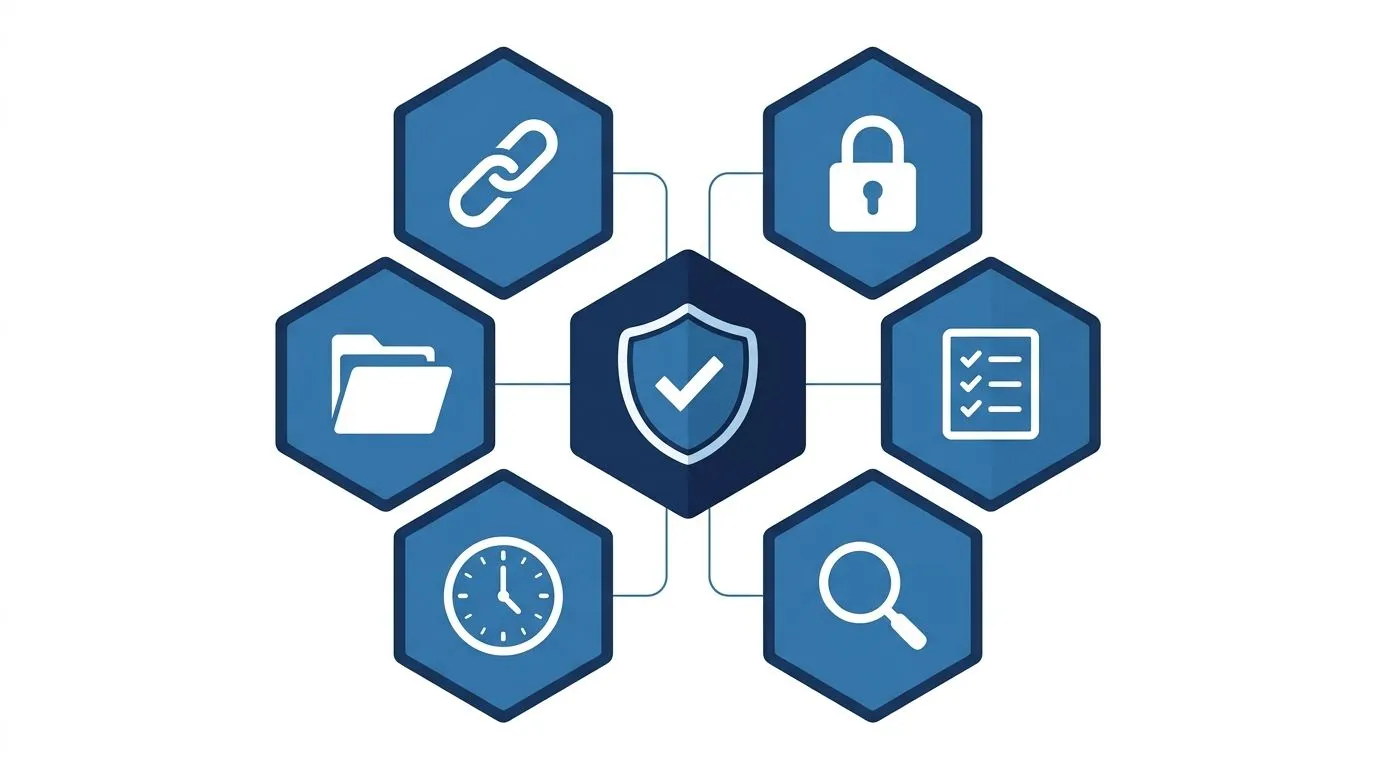
The six GoBD principles at a glance:
- Immutability – Archived data must not be altered after filing
- Completeness – No selective archiving; everything relevant must be fully preserved
- Accuracy – Content must correspond to the original
- Timeliness – Documents must be archived promptly, not years after the fact
- Order – Records must be systematically retrievable
- Traceability – A tax auditor must be able to understand and verify the entire process
The GoBD does not exhaustively define which document types are affected. It follows the purpose principle, not form. If a webcast recording documents tax-relevant content or serves as evidence of a business action, it falls within the regulation's scope.
Which webcast recordings are subject to GoBD
Not every recording carries a retention obligation. The key question is: does this webcast have a tax-relevant, liability-related, or commercially significant context?
Clearly subject to GoBD
Mandatory compliance training Workplace safety briefings, GDPR mandatory training, anti-money laundering (GwG), data protection training: all of these are subject to statutory proof requirements. The webcast recording is often the only reliable evidence that a training actually took place and who attended.
Investor relations and general meetings Earnings calls, analyst days, virtual AGMs: recordings here document commercially relevant statements that may carry weight under capital markets law (MAR) or corporate law (§ 118 AktG).
Contract-relevant information events When a webcast communicates commercial terms — such as dealer product training or legally relevant customer briefings — the recording takes on the character of a business letter.
Tax-relevant internal communications Webcasts in which decisions about tax-relevant matters are documented (e.g., budget approvals, restructurings, contract changes) may be subject to retention obligations.
Probably not GoBD-mandatory, but worth archiving anyway
Internal townhalls and all-hands meetings without tax-relevant resolutions generally fall outside the GoBD retention obligation — but may still be archived for employment law or strategic reasons.
Marketing webinars and lead-gen events are typically not GoBD-mandatory, provided no contract-relevant statements are made.
Important note: Whether your specific webcast recordings are subject to GoBD must be clarified with your tax advisor or legal department. The guidance above is for orientation only and does not constitute legal advice.
What GoBD-compliant archiving actually means in practice
Retention periods
Since Germany's Bureaucracy Relief Act IV (BEG IV), the following retention periods apply:
| Document type | Retention period |
|---|---|
| Accounting records (invoices etc.) | 8 years (since 2025) |
| Tax-relevant records, business correspondence | 10 years |
| Payroll records | up to 30 years |
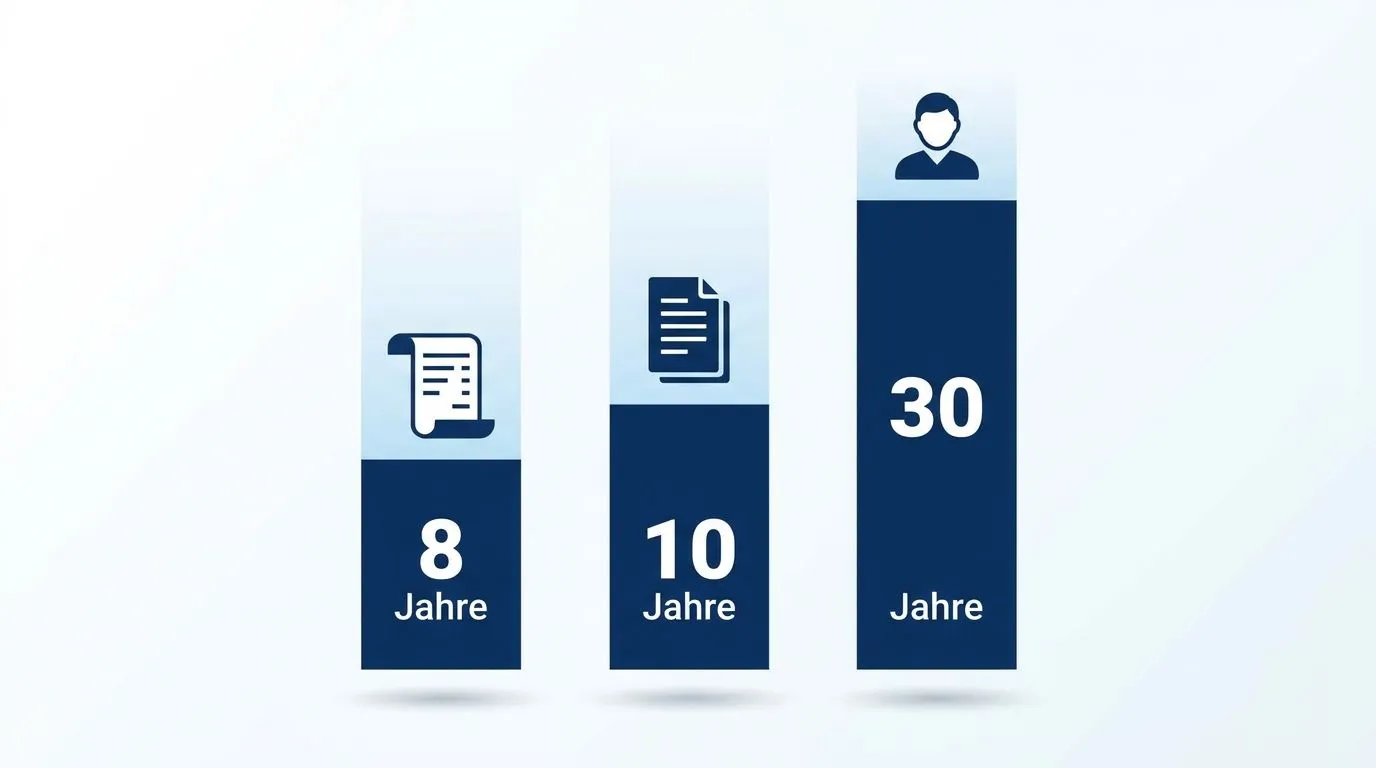
The German Federal Chamber of Tax Advisors recommends in its FAQ on digital retention (as of January 2026) archiving all digital records for a uniform 10 years to minimize risks from competing regulations. This recommendation applies analogously to GoBD-relevant webcast recordings.
Technical requirements
Immutability: The recording must be technically unalterable after archiving. Simple cloud folders or network drives without version protection are not sufficient. A write-once principle or a complete change history is required.
Machine readability: The file must be openable and evaluable without proprietary software from the archiving company. Standard formats such as MP4 for video and PDF for presentations are preferable.
Completeness: Not only the video file, but also associated metadata (date, time, attendee list, presentation materials) must be archived in full.
Accessibility: A tax auditor must be able to access the records within a reasonable time. "It's somewhere on an old server" is not a GoBD-compliant answer.
Process documentation: The archiving process itself must be documented — who archives what, how, where, and according to which process. This procedural documentation is mandatory and must itself be stored in a GoBD-compliant manner.
GoBD trap: A printout is not enough A common misconception: printing webcast attendee lists and filing them in a binder does not qualify as GoBD-compliant archiving. Under GoBD, electronically created records must also be retained electronically. A printout is not a substitute.
GoBD and GDPR: When deletion obligations meet retention requirements
Anyone archiving webcasts will inevitably face a conflict. GDPR requires data minimization and the right to be forgotten: personal data should be deleted once its purpose is fulfilled. GoBD demands the opposite. Relevant records must be retained completely and immutably for 8–10 years.
The solution lies in purpose-bound archiving with access restrictions:
What must be archived: Content with GoBD relevance (e.g., training documentation, attendance records, presentation content) is retained for the statutory period.
What gets deleted under GDPR: Recordings without tax or liability relevance, where personal data (faces, names in chat) was processed, are subject to GDPR deletion once no purpose remains.
Separate content documentation from personal data. The training recording with date and attendance metadata stays archived. Personal participant data (email addresses, camera image) is deleted or pseudonymized after the GDPR retention period.
Tip: Define your deletion concept before your first webcast Before starting your webcast programme, define which data is stored for how long and document this concept in writing. It protects you in a GDPR audit just as much as in a tax audit.
How MEETYOO Show supports GoBD-compliant documentation
MEETYOO Show is ISO 27001-certified and runs on EU servers in Germany. For GoBD-relevant records, § 146 Para. 2a AO requires that access by German tax authorities is guaranteed at all times. US-based providers carry an additional risk: the US CLOUD Act can compel US providers to hand over stored data to US authorities — which conflicts with GDPR and makes US infrastructure a calculable residual risk for compliance-sensitive webcast recordings.
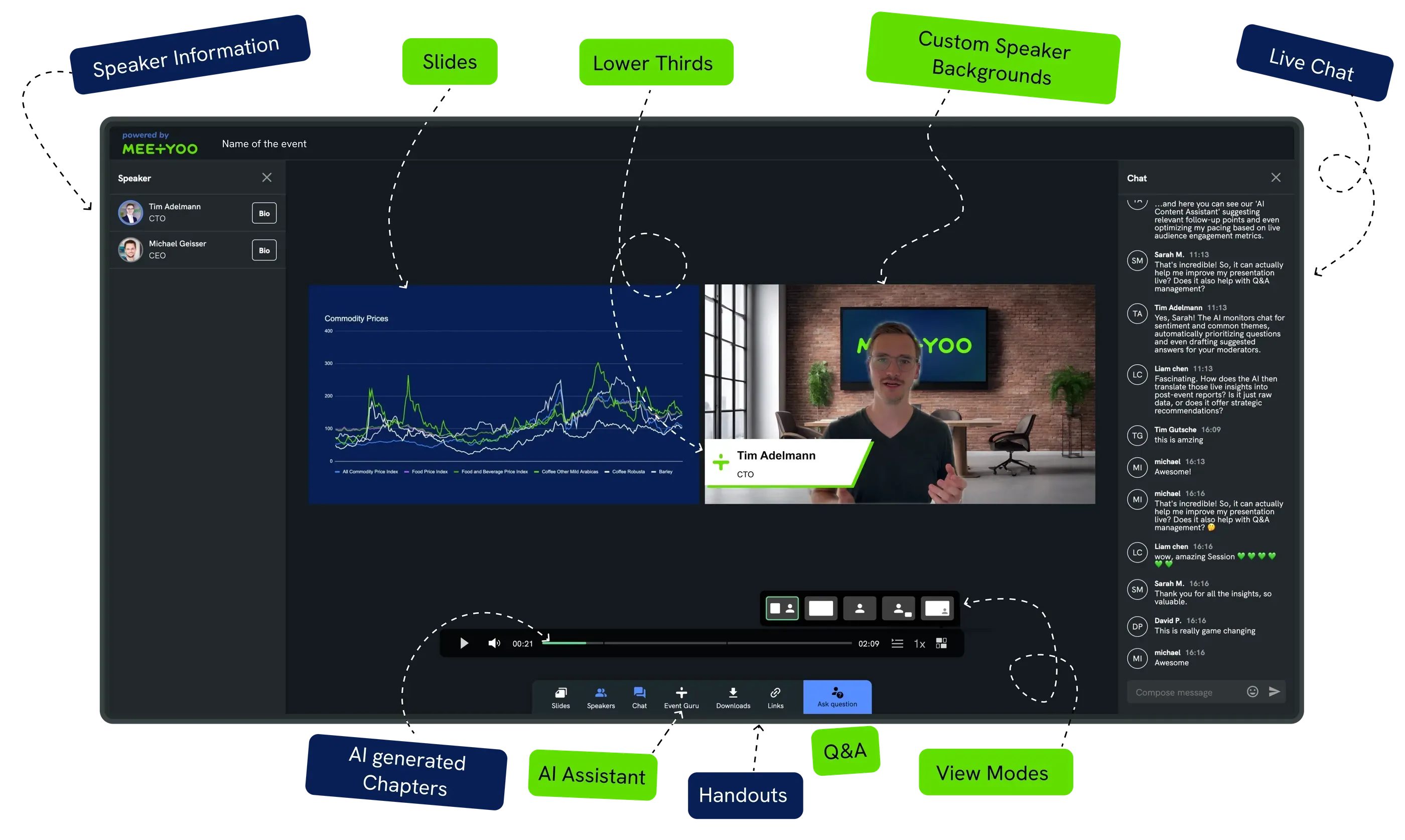
What MEETYOO Show contributes in practice:
Complete attendee reports: After every webcast, an exportable report is available — with name, registration time, and actual attendance duration. That's the reliable training proof when a regulatory authority or tax auditor comes asking.
Automatic transcripts: MEETYOO Show's transcription function generates a complete text record of the webcast. For compliance training, the transcript documents what was actually covered, not just who attended. It can be archived as a supplementary document alongside the video file. Learn more about the AI features in MEETYOO Show.
On-demand archive with access control: Recordings remain retrievable in the on-demand archive, with role-based access control. The recording is not publicly accessible, but available at any time to authorized persons.
Exportable standard formats: Recordings can be exported as MP4 and transferred into your own DMS systems. MEETYOO Show is the capture source. Your certified archiving system handles long-term, audit-proof retention.
Building a GoBD documentation process for webcasts
Step 1: Classify your webcast types
Create a simple internal classification of your webcast formats:
| Webcast type | GoBD relevance | Retention period |
|---|---|---|
| GDPR mandatory training | High | 10 years |
| Workplace safety briefing | High | 10 years |
| Anti-money laundering training | High | 10 years |
| Investor relations / earnings call | High | 10 years |
| Partner briefing with commercial terms | Medium | 8–10 years |
| Internal townhall (no resolutions) | Low | As needed |
| Marketing webinar | Low | As needed |
Step 2: Create procedural documentation
GoBD requires that you not only archive, but also document how you archive. Your procedural documentation for webcasts should cover at minimum:
- Which webcast types are archived (classification from Step 1)
- Where recordings are stored (platform + archiving system)
- Who is responsible for archiving
- Which formats are used (MP4, transcript PDF, attendee list)
- How immutability is ensured
- How long records are retained and what the deletion process is
This documentation must itself be retained and versioned.
Step 3: Export proof documents for each compliance webcast
For every GoBD-relevant webcast, export directly after the event:
- Attendee report with attendance times (from MEETYOO Show: attendee report)
- Presentation materials (PDF)
- Automatic transcript (PDF or TXT)
- Recording file (MP4)
- Metadata: date, time, duration, moderator, topic
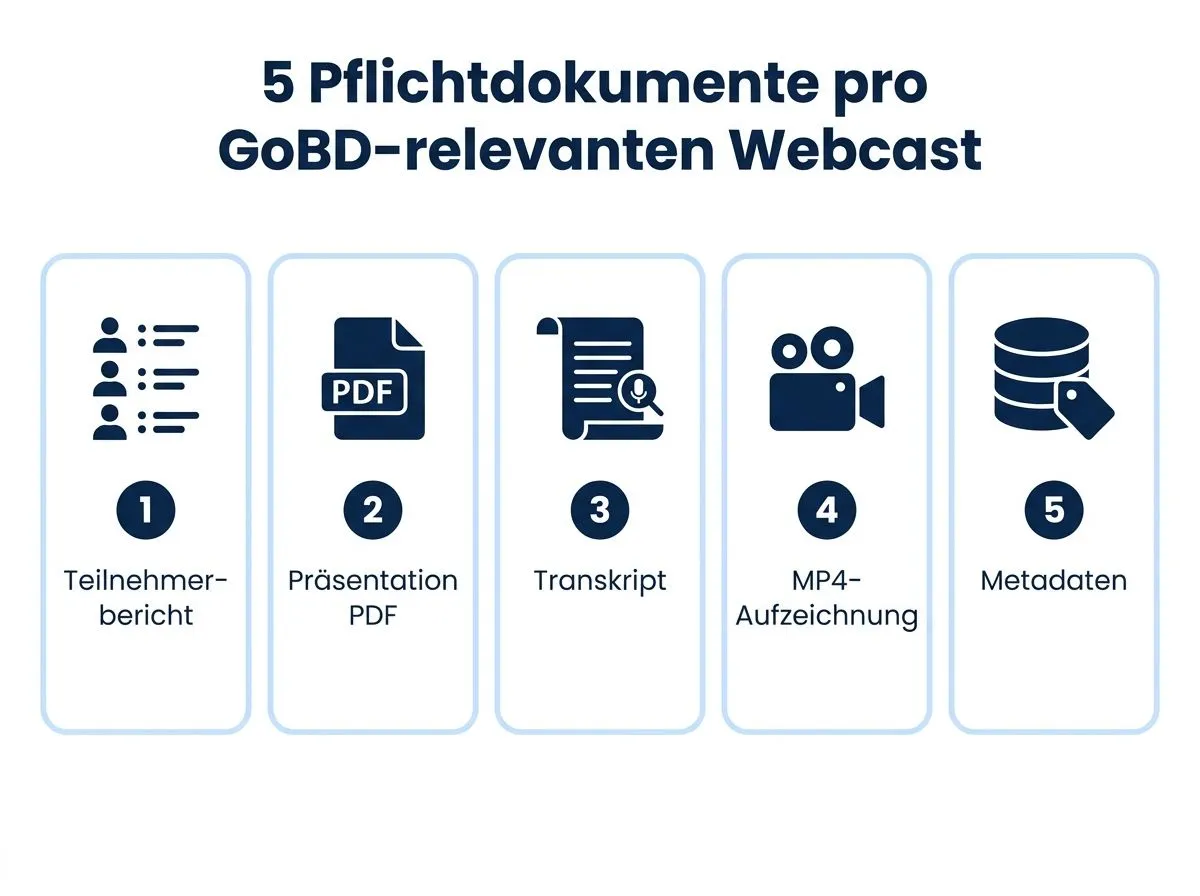
These five documents form a complete training dossier — GoBD-compliant, GDPR-conscious, and defensible if challenged.
Step 4: Choose an archiving system
MEETYOO Show is not a DMS or certified archiving system. For long-term GoBD-compliant retention, we recommend:
- GoBD-certified DMS (e.g., DocuWare, d.velop, ELO) as a central archive
- Own infrastructure with write-once storage and a complete audit trail
- Tax advisor solution for smaller companies that already use a DMS through their advisor
MEETYOO Show delivers the raw data in export-ready standard formats. Your archiving system handles the audit-proof long-term retention.
Getting started recommendation: Set up a dedicated archive folder in your existing DMS and export all GoBD-relevant webcast documents there directly after each event. No complex setup required.
GoBD checklist for webcast managers
Before your first GoBD-relevant webcast
- Webcast types classified by GoBD relevance
- Procedural documentation for webcast archiving created
- Archiving system defined (DMS or equivalent)
- GDPR deletion concept for webcast data defined
- Internal responsibilities clarified
After every GoBD-relevant webcast
- Attendee report exported and archived
- Presentation materials archived
- Transcript exported and archived
- Recording saved in standard format
- Metadata complete (date, topic, moderator, duration)
Annually
- Procedural documentation reviewed for currency
- Retention periods reviewed; expired records deleted (GDPR)
- Archive access rights reviewed
Conclusion
A clean GoBD documentation process for webcasts is not an end in itself. In a tax audit, it determines whether compliance training counts as legally proven or not. Without documentation, you risk the bookkeeping being rejected outright — and assessments made without the ability to defend yourself.
The first step is classifying your webcast types and creating simple procedural documentation. Both can be done in half a day.
MEETYOO Show provides the technical foundation: EU servers, ISO 27001 certification, complete attendee reports, automatic transcripts, and exportable standard formats. Your existing DMS handles the audit-proof archiving. MEETYOO Show overview.
FAQ
Are all webcast recordings subject to GoBD?
No. GoBD obligations only apply to webcasts with tax-relevant or commercially significant content — for example, compliance training, investor relations events, or contract-relevant briefings. Marketing webinars and internal all-hands meetings without formal resolutions generally fall outside the scope. If in doubt, consult a tax advisor.
How long must I retain webcast recordings?
The German Federal Chamber of Tax Advisors recommends a uniform 10 years for all digital records with potential tax relevance. Since 2025, classic accounting records have a shortened period of 8 years. For training records and business communications, the 10-year rule still applies.
Is storing the recording in the cloud sufficient?
No. GoBD-compliant archiving requires immutability, machine readability, completeness, and accessibility. Simple cloud folders without version protection and audit trail typically do not meet these requirements. A GoBD-certified DMS or equivalent solution is needed.
How do I resolve the conflict between GoBD retention and GDPR deletion obligations?
Through purpose-bound archiving: tax-relevant content (training records, presentations, metadata) is retained for the statutory period. Personal data without tax-law relevance (e.g., chat messages with private content) is deleted or pseudonymized after the GDPR retention period. This concept must be documented.
Do I also need to retain webcast transcripts?
It depends on the webcast type. For compliance training, a transcript is a valuable supplementary proof document showing what was actually covered. For GoBD-relevant webcasts, archiving the transcript as an additional document alongside the video file is recommended.
Does GoBD also apply to Austrian and Swiss companies?
No — GoBD is a German administrative directive from the Federal Ministry of Finance. Austria has its own regulations (Federal Fiscal Code, BAO), Switzerland follows the Code of Obligations (OR). However, the core principles — immutability, completeness, accessibility — are very similar.
How does MEETYOO Show specifically help with GoBD documentation?
After every webcast, MEETYOO Show provides complete attendee reports, transcripts, and exportable recordings in standard formats. The platform runs on ISO 27001-certified EU servers in Germany, fulfilling the accessibility requirement under § 146 Para. 2a AO.


